 All News
2019: Reducing construction waste with AI—interview with Optocycle
Celebrating ten years of Cyber Valley in 2026

In 2016, important actors from science, industry, and politics founded the Cyber Valley Consortium, which became the first Innovation Campus in Baden-Württemberg. Ten years on in 2026, we're revisiting the most important milestones from the last decade. Each month, we'll focus on a particular year since Cyber Valley's beginning.
This month, we’re looking back to 2019, when the Cyber Valley Start-up Network was founded to build and nurture a community of start-up entrepreneurs. The Cyber Valley Start-up Network has grown rapidly over the past years, from the initial seven founding members at the end of 2019 to more than 100 start-ups in 2026.
In 2022, Optocycle joined the Start-up Network. Optocycle develops AI-based systems for the optical classification of construction waste. Their technology enables optimal use of demolition material, promoting a circular economy.
In the following interview, CEO Max-Frederick Gerken explains how the idea for Optocycle emerged, how being part of the Start-up Network has supported the company’s development, and how AI-driven material classification can contribute to a more circular and sustainable construction industry.
How did the idea for Optocycle originate, and what problem were you initially trying to solve?
Interestingly, we didn’t start in construction. Initially, we were building AI to recognize fruits and vegetables at supermarket checkouts. The pivot came when a contact from the recycling industry highlighted a much bigger problem: construction waste is still classified manually: slow, subjective, and inefficient.
We realized that the core issue is missing data. That’s why we built Optocycle: combining optical sensor systems with AI to create a reliable, real-time data layer for material flows and enable true circular construction.
How did your research and experience within the Cyber Valley ecosystem contribute to founding the company?
It didn’t directly contribute to founding the company, as Optocycle was already established at that point. However, we did benefit from funding within the Cyber Valley ecosystem, which supported us in scaling our team and further developing our technology. Beyond that, the ongoing exchange within the network has been consistently valuable and interesting.
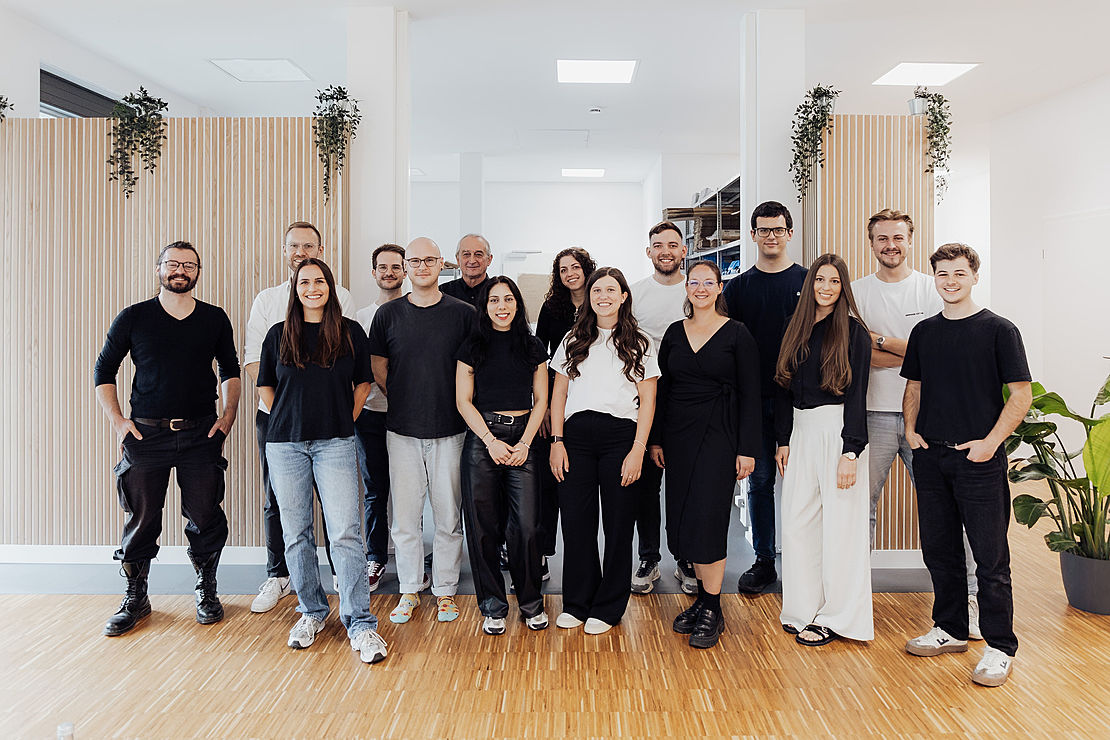
The Optocycle team | (c) Optocycle
How do you see Optocycle’s work contributing to a future where AI research has a long‑term, positive, and sustainable impact on society?
At Optocycle, we see our work as a very applied example of how AI can drive tangible, long-term positive impact, particularly in industries that have historically been difficult to transform, such as construction and circular materials management.
Our core contribution lies in using AI and advanced sensing technologies to make material flows transparent and measurable. This is a prerequisite for any functioning circular economy. Today, a significant share of valuable materials is still downcycled or lost entirely because there is insufficient data about their composition and quality. By generating reliable, real-time data, we enable better decision-making across the value chain, from sorting and recycling to reintegration into new products.
From a sustainability perspective, this directly contributes to reducing waste, lowering CO₂ emissions, and preserving finite resources. But beyond the environmental aspect, we also see a structural impact: AI, when deployed thoughtfully, can help modernize traditionally analog industries and make them more efficient, data-driven, and resilient.
Importantly, we believe that the long-term societal value of AI will depend less on abstract breakthroughs and more on its integration into real-world systems. Our approach is therefore to embed AI into physical processes with clear economic and ecological benefits. This ensures that the technology is not only innovative, but also scalable, economically viable, and aligned with sustainability goals
What was the biggest lesson you learned from your founding journey? And what advice would you give to others who are considering taking the leap?
The biggest lesson from our founding journey has been the importance of building solutions strictly around real customer needs, not for the sake of technology or innovation itself. Especially in deeptech and AI, there’s a strong temptation to develop sophisticated solutions first and look for applications later. In practice, that approach rarely leads to sustainable businesses.
What truly made a difference for us was maintaining a strong customer focus from early on: deeply understanding pain points, validating assumptions quickly, and iterating based on real-world feedback. This ensures that what you build is not only technically impressive, but also commercially relevant and scalable.
For anyone considering taking the leap, the advice would be: stay as close to your customers as possible. Talk to them early, challenge your own assumptions, and be willing to adapt your solution, even if that means pivoting away from your original idea. Execution matters, but direction matters more, and that should always be guided by real demand.
To celebrate Cyber Valley's ten-year anniversary, we'll be sharing a variety of content across our website and social media channels reflecting on milestones from the last decade. Stay tuned for the next installments!
Company Information

Related Articles
Cyber Valley AI Incubator announces batch #8 winners


2021: Founding of Cyber Valley GmbH—Interview with Floria...
2021: Critically reflecting on how AI is impacting socie...